Quo Primum; One Of The Key Reasons Many
Are Still Faithful To The Latin Mass

I stated on my "About This Site" page that I would not use a bunch of ancient documents in my articles, and I am not going to. But I do feel that one is particularly relevant and valuable for traditionally minded Catholics of the present day. I refer to Quo Primum, issued by Pope Saint Pius V in 1570, confirming the validity and standardization of the Latin Mass for all time. The language used in Quo Primum is specific and unambiguous.
An argument has been made that "one pope can change what previous popes have done." For the most part, this is true. But in order to remove and replace something that is intrinsically Catholic, that which replaces it must also be completely Catholic. Some will argue that Quo Primum cannot be nullified or superseded due to its wording and authority. That is not the main issue, however. What is called into question is whether the Mass that replaced the Latin Mass is in fact Catholic. Many people, including this writer, maintain that it is not.
The text of Quo Primum follows, with some of the key points highlighted in red.
Quo Primum
Promulgating the Tridentine (Latin) Liturgy
Pope Pius V - 1570
APOSTOLIC CONSTITUTION
From the very first, upon Our elevation to the chief Apostleship, We gladly turned our mind and energies and directed all our thoughts to those matters which concerned the preservation of a pure liturgy, and We strove with God’s help, by every means in our power, to accomplish this purpose. For, besides other decrees of the sacred Council of Trent, there were stipulations for Us to revise and re-edit the sacred books: the Catechism, the Missal and the Breviary. With the Catechism published for the instruction of the faithful, by God’s help, and the Breviary thoroughly revised for the worthy praise of God, in order that the Missal and Breviary may be in perfect harmony, as fitting and proper – for its most becoming that there be in the Church only one appropriate manner of reciting the Psalms and only one rite for the celebration of Mass – We deemed it necessary to give our immediate attention to what still remained to be done, viz, the re-editing of the Missal as soon as possible.
Hence, We decided to entrust this work to learned men of our selection. They very carefully collated all their work with the ancient codices in Our Vatican Library and with reliable, preserved or emended codices from elsewhere. Besides this, these men consulted the works of ancient and approved authors concerning the same sacred rites; and thus they have restored the Missal itself to the original form and rite of the holy Fathers. When this work has been gone over numerous times and further emended, after serious study and reflection, We commanded that the finished product be printed and published as soon as possible, so that all might enjoy the fruits of this labor; and thus, priests would know which prayers to use and which rites and ceremonies they were required to observe from now on in the celebration of Masses.
Let all everywhere adopt and observe what has been handed down by the Holy Roman Church, the Mother and Teacher of the other churches, and let Masses not be sung or read according to any other formula than that of this Missal published by Us. This ordinance applies henceforth, now, and forever, throughout all the provinces of the Christian world, to all patriarchs, cathedral churches, collegiate and parish churches, be they secular or religious, both of men and of women – even of military orders – and of churches or chapels without a specific congregation in which conventual Masses are sung aloud in choir or read privately in accord with the rites and customs of the Roman Church. This Missal is to be used by all churches, even by those which in their authorization are made exempt, whether by Apostolic indult, custom, or privilege, or even if by oath or official confirmation of the Holy See, or have their rights and faculties guaranteed to them by any other manner whatsoever.
This new rite alone is to be used unless approval of the practice of saying Mass differently was given at the very time of the institution and confirmation of the church by Apostolic See at least 200 years ago, or unless there has prevailed a custom of a similar kind which has been continuously followed for a period of not less than 200 years, in which most cases We in no wise rescind their above-mentioned prerogative or custom. However, if this Missal, which we have seen fit to publish, be more agreeable to these latter, We grant them permission to celebrate Mass according to its rite, provided they have the consent of their bishop or prelate or of their whole Chapter, everything else to the contrary notwithstanding.
All other of the churches referred to above, however, are hereby denied the use of other missals, which are to be discontinued entirely and absolutely; whereas, by this present Constitution, which will be valid henceforth, now, and forever, We order and enjoin that nothing must be added to Our recently published Missal, nothing omitted from it, nor anything whatsoever be changed within it under the penalty of Our displeasure.
We specifically command each and every patriarch, administrator, and all other persons or whatever ecclesiastical dignity they may be, be they even cardinals of the Holy Roman Church, or possessed of any other rank or pre-eminence, and We order them in virtue of holy obedience to chant or to read the Mass according to the rite and manner and norm herewith laid down by Us and, hereafter, to discontinue and completely discard all other rubrics and rites of other missals, however ancient, which they have customarily followed; and they must not in celebrating Mass presume to introduce any ceremonies or recite any prayers other than those contained in this Missal.
Furthermore, by these presents [this law], in virtue of Our Apostolic authority, We grant and concede in perpetuity that, for the chanting or reading of the Mass in any church whatsoever, this Missal is hereafter to be followed absolutely, without any scruple of conscience or fear of incurring any penalty, judgment, or censure, and may freely and lawfully be used. Nor are superiors, administrators, canons, chaplains, and other secular priests, or religious, of whatever title designated, obliged to celebrate the Mass otherwise than as enjoined by Us. We likewise declare and ordain that no one whosoever is forced or coerced to alter this Missal, and that this present document cannot be revoked or modified, but remain always valid and retain its full force notwithstanding the previous constitutions and decrees of the Holy See, as well as any general or special constitutions or edicts of provincial or synodal councils, and notwithstanding the practice and custom of the aforesaid churches, established by long and immemorial prescription – except, however, if more than two hundred years’ standing.
It is Our will, therefore, and by the same authority, We decree that, after We publish this constitution and the edition of the Missal, the priests of the Roman Curia are, after thirty days, obliged to chant or read the Mass according to it; all others south of the Alps, after three months; and those beyond the Alps either within six months or whenever the Missal is available for sale. Wherefore, in order that the Missal be preserved incorrupt throughout the whole world and kept free of flaws and errors, the penalty for nonobservance for printers, whether mediately or immediately subject to Our dominion, and that of the Holy Roman Church, will be the forfeiting of their books and a fine of one hundred gold ducats, payable ipso facto to the Apostolic Treasury. Further, as for those located in other parts of the world, the penalty is excommunication latae sententiae, and such other penalties as may in Our judgment be imposed; and We decree by this law that they must not dare or presume either to print or to publish or to sell, or in any way to accept books of this nature without Our approval and consent, or without the express consent of the Apostolic Commissaries of those places, who will be appointed by Us. Said printer must receive a standard Missal and agree faithfully with it and in no wise vary from the Roman Missal of the large type (secundum magnum impressionem).
Accordingly, since it would be difficult for this present pronouncement to be sent to all parts of the Christian world and simultaneously come to light everywhere, We direct that it be, as usual, posted and published at the doors of the Basilica of the Prince of the Apostles, also at the Apostolic Chancery, and on the street at Campo Flora; furthermore, We direct that printed copies of this same edict signed by a notary public and made official by an ecclesiastical dignitary possess the same indubitable validity everywhere and in every nation, as if Our manuscript were shown there. Therefore, no one whosoever is permitted to alter this notice of Our permission, statute, ordinance, command, precept, grant, indult, declaration, will, decree, and prohibition. Would anyone, however, presume to commit such an act, he should know that he will incur the wrath of Almighty God and of the Blessed Apostles Peter and Paul.
Given at St. Peter’s in the year of the Lord’s Incarnation, 1570, on the 14th of July of the Fifth year of Our Pontificate.
I Don't Like The Latin Mass. I Don't Understand It.

The Latin Mass. Sometimes referred to as the Tridentine Mass. It is said in Latin with the priest standing ad orientem, which means towards the altar, away from the laity. Pictured above is the consecration of the host, the most solemn moment of the Mass. This moment, the elevation of the consecrated host, happens immediately after the priest softly utters the words Hoc Est Enim Corpus Meum. "For this is My Body."
Latin was originally used because the church was based in Rome, and Rome in those early years was connected to nearly every part of the known world at the time through travel routes, economics, trade, and politics. Rome was at the center of it all. Latin remained because the language fell from common use and became static, that is, not seeing changes from cultural influences, slang, or other factors. It was consistent and unchanging. This aspect of Latin perfectly mirrored the practices and beliefs of Catholicism, and so it became the universal language of the church.
"But I don't understand it." You don't have to. When the priest is speaking Latin, he isn't talking to you. He is talking to God. The Latin Mass, properly understood, is between the priest and God. When the new Mass came about in the late 1960s/early 1970s, that aspect of worship changed when the priest started facing the laity, the language used became the local tongue, and a heavy emphasis was put on laity involvement in performing parts of the Mass themselves. In this process, the priest turned his back on the tabernacle entirely, which, in spirit and in light of historical and cultural norms and precedent, gives sufficient cause to ask if God was still the focus of the Mass.
Latin was the exclusive language of the Roman Catholic Church for many centuries, during which time the Catholic Church was a strong influence, even an anchor, of the moral fabric of society in Christian nations. The Church was respected by most, hated by some, and feared by some. Latin is a big part of what unified it and gave it purpose and influence.
It's ironic, I think, that when the Catholic Church was at its peak through the Middle Ages, the average level of education, even that of basic literacy, was very low. So most could not understand Latin or even read their own language. But there were many saints during the Middle Ages, and the seminaries, unlike today, had no problems attracting men to the priesthood, and the convents were not empty and in danger of closing like they are presently. It sounds like back then, although not understanding Latin, they understood many important things, and language back then was not a barrier to devotion or understanding and practicing the faith. Is it for you?
Fast forward to today, Western civilization sees the highest average rate of education and literacy in the history of the world, but now we reject Latin because we don't understand it? Latin isn't even the issue, really. What we have lost is understanding of the true nature and purpose and design of the Latin Mass and why it matters. Not only do we, collectively, not know what has been taken from us, but we don't even know that something of great value has been taken at all. In my observation, the price we have paid for understanding the language is that we no longer understand our faith, and many of us aren't even sure what we believe or what the church teaches. The mainstream church itself is sometimes unsure and inconsistent in its teachings.
The nearly simultaneous change in the Mass to the local language and the involvement of laity in the Mass have conditioned people to think that the Mass is all about them and it appeals to their pride. The change in language is only part of a much bigger problem, and that is that the Catholic laity have had their religious heritage and faith stolen from them, but it was done under the guise of giving them something wonderful, a "new springtime," so to speak.
If one tires of the new Mass and wants to attend the Latin Mass for the first time, it may take some getting used to. There are missals (prayer books for the Mass) available that have side-by-side Latin-to-English translations to help follow along. The Latin Mass may be a little longer. But the difference in reverence will be immediately evident, as will be the way people dress for Mass. It will be easy to see that what adherents to the Latin Mass believe predates what adherents to the new Mass believe and that it is more firmly rooted in the traditions of the Catholic Church.
I would encourage my readers to investigate the Latin Mass. See why people cling to it with so much devotion. It isn't nostalgia. It is faith and an understanding of what our heritage as Catholics truly is. and the need to keep it and pass it on.
Easily Observable Problems With The
New (post 1969) Catholic Mass
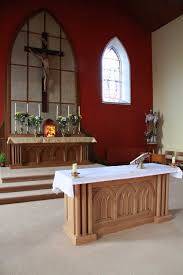
1) Catholics adhere, ot at least give lip service to, to a belief in the real presence. That is to say that Jesus Christ is physically present in the consecrated host (communion wafers). These are kept in the tabernacle, the gold object in the center of the altar against the wall as pictured. Yet during the Mass, when the priest bows or genuflects, it is never to the tabernacle and usually with their back to it. The rubrics of the new Mass direct them to disrespect and turn their back to He whom they claim to be worshipping. All through history one would always face the focus of one's homage given, in any religion and in any culture. Isn't it odd how mankind has, figuratively and otherwise, turned their back on God, and at the same time the priest at the new Mass physically turns his back on God, whom he believes to be physically present? What message does that send to those in the pews? What message has it been sending since roughly 1969? This contradiction between words and actions in the altar space cannot be reconciled.
2) When Catholics approach to receive communion, depending on the church, some may kneel to receive it on the tongue as it has been for nearly 2000 years. Some may take it on the tongue standing up, and some may take it in the hand. Referring back to the first point made about the real presence, how is it that the modern church teaches that these methods are all equally acceptable, and yet they all manifest different levels of reverence, humility, and faith? The obvious impact of this permission is a diminishing and diluting of faith and reverence. Ultimately, practice is based on faith. Does one who habitually receives communion in the hand believe the same thing as one who reverently kneels to receive? While one cannot judge what is in a person's heart, practice is based on faith.
3) If I were to photograph 30 people shopping at Walmart and 30 random people at the new Mass and then photoshop the images to remove the backgrounds, would anyone be able to tell which person was from which environment? Just a few generations ago, dressing properly for Mass was something people did without question. Dressing properly was done not just out of respect for God but out of respect for each other so as not to be distracting during Mass. While lack of proper respect in attire at Mass is a problem, it is only symptomatic of the bigger problem, which is that the modern church not only allows but tacitly encourages this lazy and disrespectful behavior among the laity. As mentioned previously, practice is based on faith. What one does, especially in church, is a manifestation of what one believes. That which one believes, and therefore practices, will be impacted significantly by the teachings and rules of the organization in which one's beliefs are based and taught.
Are there any solutions to problems like this?
Yes, there are. For the long term, eventually the Catholic Church will be restored to its former glory and proper place. The means by which this will happen is not known to me, but I do believe it will happen.
For the short term, seek out chapels that offer the traditional Latin Mass. If you are tired of the nonsense of the modern church but have never been to a Latin Mass, they can take some getting used to. There are a number of organizations that offer the Latin Mass. To see if there might be a Latin Mass near you, visit www.traditio.com for a frequently updated directory of Latin Mass locations.
Why Do Some Catholics Not Like The Divine Mercy Devotion?

The Divine Mercy devotion is very popular in the mainstream Catholic Church. It comes from the writings of Sister Faustina Kowalska of Poland, who was canonized under questionable circumstances by Pope John Paul II on April 30, 2000. Those circumstances are not the focus of this article but are part of the bigger, also important question concerning the changes since Vatican II on how canonizations are decided upon in the mainstream church.
There are numerous red flags in the book Sister Faustina wrote that call this devotion into question, and many traditional-minded Catholics reject this devotion for those reasons. At the same time, there are two big reasons one can see without even picking up the book. It is those two things that this article will discuss.
1) The official, supposedly divinely inspired image of Christ, shown above, that is associated with the Divine Mercy devotion is wrong. This image does not show the Sacred Heart of Jesus. which is supposedly where the red and blue rays emanate from. Is the Sacred Heart hidden because we aren't supposed to think about it anymore or continue the devotion to the Sacred Heart? Is the Divine Mercy devotion intended to eclipse the Sacred Heart devotion? How does it not at least implicitly do this?
It is not without precedent that there can be more than one devotion for Jesus, or the Blessed Virgin Mary, or some of the saints. At the same time, it is without precedent that one devotion eclipses or obscures another. Jesus established the Sacred Heart devotion to Saint Margaret Mary Alacoque in the 17th century, and Jesus, as we can see in scripture, is not wishy-washy and does not change His mind about anything. The question is not, as many will say, "But Jesus can do whatever He wants; who are you to question Him?" But rather, is this something He would do? Jesus will always be consistent and true to His nature, in part because He wants to be recognized. He also wants to be distinguished from elements that might seem to be Him or from Him that in fact are not. It's a matter of faith and critical thinking.
Another aspect of the "official image" that is suspect is the fact that the wounds of the crucifixion are not present. Why? This oversight is not trivial. The wounds/scars of the crucifixion are an important part of the identity of Christ. This is not a secret. If one wishes to speak of the mercy of Christ, it is precisely because of His crucifixion and death that He is able to grant mercy. So why aren't the wounds represented on the image? Who is the image really of? I intend no disrespect to our crucified Lord when I say this, but if Christ had mugshots like those used by modern-day law enforcement noting significant marks for identification, the official image shown above would be rejected as that of Christ.
2) The fact that the rosary is used to recite the Divine Mercy devotion makes the devotion highly suspect. Over the centuries there have been many devotions and chaplets, but never before, to the mind of this writer, has the rosary been appropriated for something other than that which the Blessed Virgin Mary intended it to be when she gave it to Saint Dominic in the early 1200s.
Again, many might say, "But who are you to question what Jesus can do?" It's not a question about what Jesus CAN do. It never was. It's a question of what He WOULD do. The nature of the relationship between Jesus and Mary is partly revealed in the last recorded words of Mary in scripture, when she says to the waiters at the wedding at Cana, "Do whatever He tells you." This instruction has two layers. The first and most obvious is for all of us to obey her Divine Son. But the second, understood in the context of the situation, was Mary instructing Jesus to solve the problem of there being no wine. Jesus obeys his mother not just out of maternal respect but also out of respect for her important role in mankind's hope of salvation. With these things in mind, would Jesus really appropriate the rosary for something other than that for which it was intended?
Without even picking up Sister Faustina's book, one can see how the Divine Mercy devotion serves to eclipse two much older and more important devotions: that of the Sacred Heart of Jesus and the holy rosary of the Blessed Virgin Mary. While many people practice the Divine Mercy devotion with the best of intentions and are blameless in that pursuit, it doesn't take much critical thinking, as shown here, to demonstrate that this devotion is very likely a false one, and that is why many traditionally minded Catholics, including this writer, want nothing to do with it.
The new Mass and the religion attached to it have many novelties and innovations, but the most efficacious things to use to save our souls and to help others do the same have been around for many centuries and are not in need of any improvement or novelty.
God bless you, my friends.
The Mainstream Church And It's New Religion,
Caught In The Act.
As you review the items in this short article, consider these words from Pope Leo XII, Ubi Primum, #14, May 5, 1824:
"It is impossible for the most true God, who is Truth itself, the best, the wisest Provider, and the Rewarder of good men, to approve all sects who profess false teachings which are often inconsistent with one another and contradictory, and to confer eternal rewards on their members… by divine faith we hold one Lord, one faith, one baptism, and that no other name under heaven is given to men except the name of Jesus Christ of Nazareth in which we must be saved. This is why we profess that there is no salvation outside the Church"
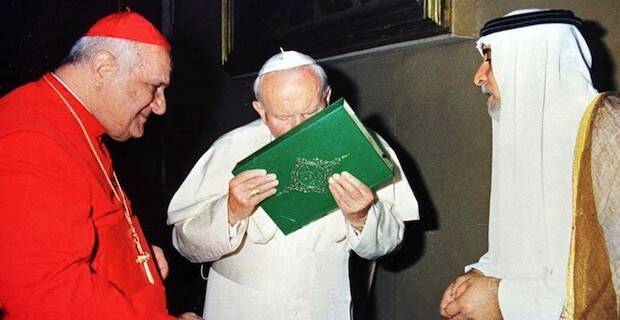
Pope John Paul II photographed kissing the Koran, the holy book of Islam. The Koran contains numerous blasphemies and also instructs its adherents to murder Christians. This action by Pope John Paul II is by definition an act of apostasy and imparts scandal upon the entirety of Christendom.

Pope John Paul II worshipping/praying with the leaders of most of the world religions. The majority of those present don't believe in Jesus Christ or the one triune God. So exactly who were they praying to? This unfortunate event took place in Assisi in 1982.
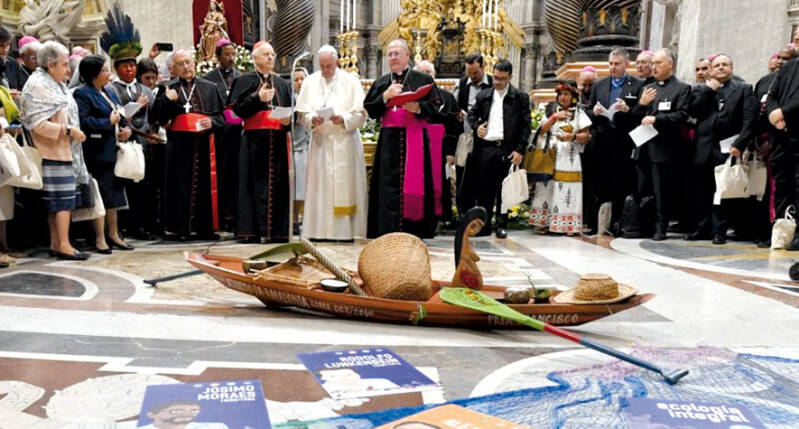
Pope Francis welcomed a pagan idol, the "pachamama" into Saint Peter's Basilica in Rome. It is the wooden figure ahead of the basket in the boat. This figure represents the pagan earth mother goddess worshipped in South America. Pope Francis and the clergy in attendance went on to pray to this idol. See the prayer sheets they are holding. This is a serious act of apostasy, regardless of what it was intended to be, and imparts scandal to all of Christendom.

This image is that of six Protestant theologians that were invited to the Vatican by Pope Paul VI . The purpose of their visit was to help shape and guide the development of the Mass that replaced the Latin Mass. Pope Paul VI wanted to make sure that the new Mass did not offend the sensibilities and beliefs of the Protestants, but at the expense of maintaining the faith and reverence of the Catholics, upon whom it was forced shortly thereafter, around 1970.
It is these examples and so many more that are driving many Catholics back to tradition, back to the Latin Mass.
The Bible On The Importance Of Tradition

This is an excerpt from the second epistle of Saint Paul to the Thessalonians, chapter 2. Saint Paul is unambiguous in his instruction on the matter of tradition, highlighted in verse 15. The whole of chapter 2 is included to give the fullest context.
2 Thessalonians 2
[1] Now we beseech you, brethren, by the coming of our Lord Jesus Christ, and by our gathering together unto him,
[2] That ye be not soon shaken in mind, or be troubled, neither by spirit, nor by word, nor by letter as from us, as that the day of Christ is at hand.
[3] Let no man deceive you by any means: for that day shall not come, except there come a falling away first, and that man of sin be revealed, the son of perdition;
[4] Who opposeth and exalteth himself above all that is called God, or that is worshipped; so that he as God sitteth in the temple of God, shewing himself that he is God.
[5] Remember ye not, that, when I was yet with you, I told you these things?
[6] And now ye know what withholdeth that he might be revealed in his time.
[7] For the mystery of iniquity doth already work: only he who now letteth will let, until he be taken out of the way.
[8] And then shall that Wicked be revealed, whom the Lord shall consume with the spirit of his mouth, and shall destroy with the brightness of his coming:
[9] Even him, whose coming is after the working of Satan with all power and signs and lying wonders,
[10] And with all deceivableness of unrighteousness in them that perish; because they received not the love of the truth, that they might be saved.
[11] And for this cause God shall send them strong delusion, that they should believe a lie:
[12] That they all might be damned who believed not the truth, but had pleasure in unrighteousness.
[13] But we are bound to give thanks alway to God for you, brethren beloved of the Lord, because God hath from the beginning chosen you to salvation through sanctification of the Spirit and belief of the truth:
[14] Whereunto he called you by our gospel, to the obtaining of the glory of our Lord Jesus Christ.
[15] Therefore, brethren, stand fast, and hold the traditions which ye have been taught, whether by word, or our epistle.
[16] Now our Lord Jesus Christ himself, and God, even our Father, which hath loved us, and hath given us everlasting consolation and good hope through grace,
[17] Comfort your hearts, and establish you in every good word and work.
Saint Paul clearly understood the value and importance of apostolic tradition long before it came under attack at the Second Vatican Council (1962-1965). We need to embrace that knowledge in modern times as well.
"To bring about change, you must not be afraid to take the first step."
Rosa Parks
Create Your Own Website With Webador