An Overdue And Necessary Conversation
About Virtual Meetings

Technology is an ever-changing, continuously evolving thing. Ever since COVID, one technology development that has firmly dug its heels into society is the virtual meeting. This is especially evident in the areas of business and education, and as COVID created a significant increase in remote work and online classes, it follows logically. Remote/virtual meetings are here to stay.
I don't begrudge the existence or use of this amazing technology. The fact that it came about at all was completely inevitable, and its use is efficient, saving significant expense and time in bringing people together. With my current employer, all members of my team work remotely over a multi-state area, so getting together in one place for the biweekly meetings would be impractical.
For all of the efficiency that can be attributed to virtual meetings, they lack a level of effectiveness and are, in this writer's opinion, overused out of convenience and sometimes laziness. Seeing a person's face on screen and hearing their voice is not the same thing as meeting them. The screen still puts up a barrier between people and inhibits the flow of energy and limits creativity and the exchange of ideas. There is an energy exchange between people when they are at the same table that can never be present on the screen. This energy causes ideas to flow and facilitates growth and understanding and often, trust as well.
Relationships in business, between supervisors, subordinates, and peers, will see the healthiest, strongest, and most organic growth through in-person meetings. I think this matters because relationships are the foundation of society, culture, and success. The biggest impact that people can have on other people has always been in person, and it always will be. Let's continue to use virtual meetings because they have a place and purpose. But let's meet in person when we can. There will be dividends from doing so, both short and long term.
I can virtually guarantee it.
Common Errors Of Modern Thought

To put it simply, one thing the world needs more of is critical thinking people. While history shows me that critical thinking rarely gets one a seat at the "cool kids' table," it is a skill that can enable one to navigate confusion and dispel errors.
Some common but widely accepted errors in modern thought are:
"The world keeps changing, so the Catholic Church needs to change with it."
This premise could not possibly be any more incorrect and sinister in its simple-sounding logic.
The fact is that the more the world changes, the more it needs for the Catholic Church to NOT change. If the world keeps changing and the one thing that keeps people morally and spiritually centered changes right along with it, then the rate at which morality, ethics, and culture unravel will increase and be unchecked over time. The idea that Catholicism, once the bastion of morality in Western civilization, should somehow be subject to the whims of a changing world is absurd. Yet, that is precisely what is happening with the mainstream Catholic Church and has been since the Second Vatican Council (1962-1965). The bad fruits of these changes are many, but enumerating these is not the focus of this article.
"If there was a God, there wouldn't be any suffering and war in the world." (Or some similarly worded nonsense.)
This statement is loaded with hubris as much as it is falsehood.
I mention hubris because it is the height of pride to assume that God, the creator of the universe, is somehow limited to operate within the very finite mind and comprehension and insight of a human being. The Creator is not subject in any way to the limitations of that which He created. We are the creation, and our understanding and perceptions are very limited when it comes to grasping the infinite wisdom and plan of God and the scope of creation. What God does and allows is subject neither to our understanding nor approval.
The statement "If there was a God..." can only come from someone who overestimates their own place in creation and their own importance. That is a dangerous place to be. Humility is a close companion of wisdom and a sensible virtue to practice.
"I don't want to bring children into this world."
I don't know if this statement is based more on cowardice or laziness. It definitely is not based on critical thinking.
There are many problems in the world we live in. None of us was promised an easy go of it, and as the years go by, the prospect of raising a child gets more and more challenging. The most important part of that unpleasant truth is that all of the problems and difficulties that people face now and will face in the future are caused by people and therefore can be fixed or, at the very least, mitigated by people.
My recommendation is for couples to have children as circumstances permit and raise them right to be the problem solvers, heroes, and saints that the world actually needs. Instill in them such virtues as faith, humility, and courage. If the next generation does not value these things, then the generation after has no chance at all. That is the big picture, and even though I don't presume it to be easy, few things that are worthwhile are. The biggest difference we can make, the biggest contribution we can make for future generations, will all be in how we raise the next generation. It will be in the impact we make on our own children.
One person can make a difference. It can start with you.
The Power Of Language

Having been born in the late 1960’s and being a cradle Catholic, I have witnessed many changes in the Catholic Church in the years since. There has been invention, reinvention, renewal, and novelty. All of these in numerous forms and flavors, but the intent of this article is not to enumerate them all. Rather, there is one simple and very subtle thing that has surfaced recently. This thing has been used by the church seemingly innocently, but with damaging consequences to the faith.
What is this subtle but damaging thing? It is a word, a simple, almost sleepy word that flies below most everyone's radar...but not mine. And after you read this, it should definitely show up on your radar as well. Have you ever encountered this word, you may be wondering?
Well friends, you just did. The word in my cross hairs is "encounter."
I have seen it used in the following ways by the mainstream church, and I am sure there are other ways as well:
"A journey of encounter."
"A culture of encounter."
"An encounter with Jesus Christ." ( I didn't even want to type that, it is in such poor taste. )
" You can encounter God in new and exciting ways." ( This in an advertisement for a retreat. )
And then there is this truly breathtaking gem from Pope Francis:
Pope Francis urges the Christians ( in Morocco, added by me ) present not to think that they should be the ‘flour’, in order to be significant. “You know very well that our lives are meant to be the ‘yeast’”, he says. He explains that “being Christian is about an encounter”, and not “about adhering to a doctrine, or a temple or an ethnic group”. Because, he says, “we are Christians because we have been loved and encountered”.
The above is from an article in "Vatican News," authored by Francesca Merlo.
When most Catholics in the pews hear the word "encounter" they actually think they know what it means, even in context. It is not in the nature of too many modern Catholics to question anything, and even the whole child sex abuse scandal isn't getting the degree of outcry from the rank and file Catholics that it truly merits.
So just what does encounter mean, anyway? Would that be a good thing to know before moving on? You might be surprised.
Oxford says:
VERB [WITH OBJECT]
1 Unexpectedly be faced with or experience (something hostile or difficult)
‘we have encountered one small problem’
2 Meet (someone) unexpectedly.
‘what do we know about the people we encounter in our daily lives?’
NOUN
1 An unexpected or casual meeting with someone or something.
‘she felt totally unnerved by the encounter’
1.1 A confrontation or unpleasant struggle.
‘his close encounter with death’
Google online says:
VERB
1. unexpectedly experience or be faced with (something difficult or hostile).
"we have encountered one small problem"
"the guides will help if you encounter any problems"
NOUN
1. an unexpected or casual meeting with someone or something.
"I told them of my encounter with the priest"
...............................................................................................................
So, based on proper definitions, being a Catholic is about a journey or culture of unexpected meetings and/or difficult and hostile experiences. What does that mean? Where does faith and practice come into it?
Here's a news flash for the mainstream church and the architects of its defective language and usage: Unexpected meetings and hostile or difficult experiences are part of everyone's life. There is nothing exclusively or uniquely Catholic about any of that.
The use of the word encounter by the mainstream church has a very trivializing effect on everything it touches. This due in large part to the consistent ambiguity in its use. When the church speaks of "an encounter with Jesus Christ" it has a subtle effect of denying His true nature and re-imagining Him in a very emasculated and incapable fashion. This due to the fact that Jesus Christ, the Son of God who rose from the dead, isn’t a person that one would have a simple encounter with. To put it another way, would Saint Paul or Saint Gertrude the Great or Saint Margaret Mary Alacoque or Saint John of the Cross or Saint Theresa of Avila describe the experiences they had as Jesus appeared to them as mere "encounters" based on the actual meaning of the word? Would they have considered it casual? Would you?
I am therefore convinced that the frequent use of the word encounter by the mainstream church has both the effect and intention to weaken the faith of the laity by further distancing itself from the true identity and reality of Jesus Christ and the Holy Trinity.
One could, I suppose, try to stretch the meaning or context of the word encounter to fit sort of or somehow, but it will never fit properly. The Catholic Church through the centuries has always used surgically specific and precise language in it's teachings and proclamations, at least up until the fatal ambiguity of Vatican II and its subsequent disastrous fallout.
Some may be tempted to dismiss the careful and timely dissection of this issue as trivial and myopic. They are free to do so, but it is never just the one thing in the mainstream church. There is always more. In addition, I am not the only Catholic out there who has a "gut sense" that something is wrong and out of place with the use of the word encounter, and some of my readers likely walk among them.
The word encounter would seem to be a tool used by the modern church to beat back what is likely a great fear, and that is that folks like you and I might just actually believe in something and have an unshakable faith. It would seem to be precisely that of which they are afraid to encounter in a dark alley.
Comfort, Convenience, and Western Civilization.

I was sitting in the recliner, feet propped up, remote, snacks, and drink close at hand, and Tom Selleck was playing his part flawlessly in front of me as a rerun of Blue Bloods was playing on the big screen TV. I’m still amazed by the HD effects these new units have, aren’t you?
As fate would have it, the telephone rang. Not my cell, which was resting comfortably in my shirt pocket, but the landline. The cordless landline was several feet away, docked in its base as it should be, every bit as comfortable as I was. The landline calls are never for me, but there’s always that chance…
With a groan and a tap of the pause button on the remote, I pulled myself out of the chair and stepped over to the phone, only to find an automated message that somebody’s prescription was ready at Walgreens. Well, I more or less already knew that. I returned to my chair, flipped up the footrest, and let Tom Selleck pick up where he left off.
The foregoing incident, while not uncommon, was still enough to give me pause. The phone had to be answered, I suppose, and I had to make myself a little bit uncomfortable to accomplish that. Most of Western civilization has found itself very comfortable too, but the myriad problems of the world continue to rage on around us. The core and most noteworthy of these problems would be the profound crisis in the Catholic Church, as the moral decay and fallout from it have worked their way into nearly every aspect of life.
While many thick books can and have been written about different aspects of the problems in the Catholic Church, that is not the intent of this work, but rather to focus on the responses of most people to it. And that is simply this: the vast majority of Catholics in the world today are too comfortable with the way things are in the church.
An incredible discomfort is the best that can be hoped for if the typical Catholic were to learn and accept the truth of what has been happening in the Church since the 1960s, such as the deceptions put forth by Vatican II, the unquestioned changes to Catholic devotion by Pope John Paul II, the false canonizations, and other darker, more sinister things behind the curtain. However, the more probable response is denial due to a lack of understanding of the true faith or simple apathy.
Growing up, Mom used to say, quoting someone I don’t know, “As the church goes, so goes the world,” and times were better then, hard to believe as that is. We see this playing out before our eyes right now. I think even Stevie Wonder can see it.
For the sake of their own souls and for the sake of civilization as we know it, people have to made uncomfortable. Perhaps metaphorically speaking, people aren’t getting out of their chairs to answer the call, and it isn’t Walgreens!
Any major change or shift in thought throughout world history has started with a single voice. Will it be my voice, or will it be yours? Things need to be shaken up; people need to be made uncomfortable. Until that happens, if it ever happens, Western civilization as we know it is not destined to fare well.
Most priests are lulling their flock into a mindless spiritual fugue, many with clever sermons filled with things that people want to hear but rarely, if ever, what they need to hear. I would like to say the problem goes back to the pulpit, but no, it goes back to the seminary, to the bishops, and ultimately to the endless compromises and capitulations and doctrinal ambiguity brought about by Vatican II.
It’s a debacle that even Tom Selleck’s Frank Reagan and his politically savvy advisors could not figure out for sure, but it would be entertaining to see the Blue Bloods scriptwriters take a shot at it. I think next time, though, I’m going to take the cordless phone with me when I sit down.
God bless you, my friends.
Image credit: Adam Pick
Playground Memories

It was always the same on the playground, from elementary school to high school. Lining up in gym class for some team-based sporting event and having the teams be picked by the chosen team captains. Every class has one, and it was me. I was the kid who always got picked last. I think a few times the kid on crutches got picked before me. Being a geek has its unique rewards, I guess.
When it was my turn to bat in baseball or softball, the team in the field would always take several steps inward. Humiliating as this was, I still managed to tap a number of base hits and triples, but I would still be picked last for future sporting events.
Now that I am older, married, and have a few somewhat geeky (make that gifted) children of my own, I look at the world differently through seasoned and more mature eyes. I see the strife in the world on social, economic, and political fronts: racial unrest, corruption, crime, dishonesty, perversion, etc. All of these issues, sadly, are both within and without the mainstream Catholic church.
There is now and has been for many years talk about these being the end times and there are indications they may in fact be so, although the last rapture prediction came and went without it occurring. Truly we know not the hour or the day.
Even with all of the doom and gloom and threats to peace and our way of life, I think it’s important to remember something: We have been picked, and maybe, just maybe, picked last.
We all have a calling, a mission in these times of unprecedented conflict and confusion. For most of us, our calling is nothing grand or heroic in the big picture, but just to do what we are supposed to do as our station in life requires. We have been picked by God for these times, times that in some ways may pose greater challenges than those faced by some well-known saints, and I think that is a reflection to feel good about. Even in these troubled times, the importance of what we do and say, especially as it relates to the faith, is a direct reflection of what we believe.
The fact that God has picked us for these times means that the grace fueled potential to solve many of the world’s problems exists within us, supplemented by the courage, wisdom, and faith that we must find within ourselves. We must also make sure they are kindled within our children, as what they are likely to face will be worse than what we deal with today.
It would be reckless at best of me to say that I have all the answers because I don’t. The most important place to start, though, is to ask the right questions. Too few people in high places, chosen to be in those high places, are doing this.
Metaphorically or otherwise, when it’s your turn to bat and you don’t know what the pitcher is going to throw, choke up on the bat, pay attention, and swing, straight, level, and true no matter how the other team taunts you. God has picked you for this, here and now.
God Bless you, my friends.
God Rest Ye Merry Gentlemen
This article was written in Advent of 2018

The holidays are finally upon us, and as they do every year, they give cause to reflect. The holidays in America, at least as they have been part of my life seem to change a little bit every year. I feel some melancholy as I am, through the passage of time, pulled inexorably further from the mystery and unfettered joy that characterized the holidays...most especially the Christmases of my distant youth.
One can certainly point out, as has been often done already, the excessive commercialization and secularization of Christmas. While these are factors in what I observe and feel, they are but one piece in a larger and darker puzzle.
The passage of time, memory, and hope are in a sense like sitting in a subway station. Although not in this case the one that makes sandwiches. Eating one of those has never filled me with hope, to be sure.
What I mean is this: When the train pulls up from where it has been and stops, one can see where it is right now, and for a moment as the doors open and the passengers load and disembark, the senses are bombarded with the sights, sounds, breezes, and sometimes even smells in that moment. But that moment is all that the senses can perceive. The train has come from somewhere and in a moment will continue on, beyond one's ability to see, hear, or otherwise be aware of it in a sensory way.
I feel this is relevant because if we consider the changes and dilutions to the holidays today, like the train in front of us, and yesteryear, from whence the train has come, then we must also consider the future. That is to say, where the train is going. A good example of this is that in recent years many retailers have had the audacity to open on Thanksgiving Day. Even the once safe auto parts industry in which I earn my own living has been significantly impacted as it has capitulated to follow the example set by other retailers.
But the train will keep on going...and going...and going. The train moves at a steady speed, but society moves at the speed of greed, avarice, selfishness, and apathy. I just wonder how much further the train has to go before Christmas falls to the same fate as Thanksgiving?
I'm not trying to be a doomsayer, really, but I do know that the train will keep going. Beyond my sight, beyond my hearing, but not beyond my hope.
The Christmases of my youth might best be described as a Norman Rockwell painting come to life. It was a sensory overload. Everything from the scratchy holiday sweaters we wore, the bright colors and makeup that my aunts wore, the smell of their perfume, the endless smiles and laughter, the tables loaded with endless varieties of festive foods and sweets, the clink of ice cubes floating in glasses filled with mysterious drinks I would not try for many years to come, the crackle and heat of the fire in the fireplace, the frost on the windows, the Christmas carols played at a somewhat subdued level on the living room stereo, the youthful carefree conversations with cousins, and the cascade of holiday greetings and cheer that grew a bit louder as each new reveler and family came through the door, trying as they might to keep out the cold and snow. The twinkling of lights, garland, and Dickensian shiny glass orbs on the Christmas tree, and the recurring question from curious aunts and uncles trying to get the inside scoop on what Santa would sneak down the chimney this year.
Of course I never forgot, even at a very early age, the religious significance of Christmas, but the felt banners with crude cutouts and the habitless nuns that were ever present at the liberal church we attended at the time didn't do the best job of driving that home. That credit goes to Mom. Dad's contribution came in his support of Mom's guidance and the good and ethical example that he set.
Christmas is rooted in Catholicism, but as Catholicism is largely composed of traditions and customs, so also is Christmas...or at least it was. Because of the unfortunate changes in the world we live in, my kids won't have the memories of Christmas that I did, and that pains me beyond description. It is perhaps this more than anything else that drives me to write this article.
But what are these changes? Well, when I was a kid, my dad didn't work 60-80 hours a week. When I was a kid, we knew who our neighbors were and knew everybody up and down the street. When I was a kid, our lives weren't complicated by technology deceptively marketed to us as being something to make life easier. When I was a kid, Mom didn't have to work. When I was a kid, serious illness wasn't so rampant. When I was a kid, the little things really did mean a lot. When I was a kid, we didn't take each other for granted. When I was a kid, there was no pressure to be anything but a kid. When I was a kid there was more faith, hope, and charity. When I was a kid, things mattered. I'm sure this list only scratches the surface.
The onus is on me—well, all of us really—to make sure that these lessons and values are passed on to our kids, and I try to do this. Still, it saddens me that they will never know the Christmases that I did at their age.
Advent is now upon us which will inspire reflection of different or maybe similar sorts in many of us. I think what we need to remember is that even in the face of these changes, pressures, and societal deficiencies, what we are responsible for has never changed, whether it be to God, to our families, or to society.
I haven't lost hope, and neither should you.
Let nothing you dismay.
A Visit To McDonald's With A Side Of The Future
This article was written in 2018.

I wasn’t overly fond of working Sundays, but such is the curse of working retail as I did at the time. Even so, I try to find the silver lining in everything, and Sundays definitely have one, especially in the morning. Sunday mornings, at least in the quiet hamlet of Fox River Grove, Illinois, are very peaceful and unhurried. Even the McDonald's near the auto parts store that claims most of my waking hours was nearly empty, and as I approached the counter to order my Sunday morning indulgences, I noticed I had the counter all to myself.
I waited a few short moments for the attendant to appear to take my order, and while waiting, I looked around. I saw that a self-order kiosk was installed a mere 8 feet or so from the counter, but it was turned off at the time. Even if it were on, I still would not have leapt at the chance to use it.
Soon a Mexican woman dressed neat as a pin in what appeared to be a new uniform appeared at the counter and asked what I would like. She smiled a lot, and it seemed genuine, and she read the order back to me in passable English. I paid her and then she thanked me and stepped away to assemble the order. She was very pleasant and had her own distinct identity and personality. Though she didn’t seem to be a manager, she demonstrated the traits and habits that could make her very successful in that business, and I give her kudos for that. It is an industry in which I would not have the patience to succeed in like manner. Though having said that, it doesn’t explain why I was in auto parts, I know.
As she brought my order to me, I asked her the following question: “What do you think? How does it benefit me, the consumer, to use that thing (indicating the self ordering kiosk) differently from ordering from the counter?”
She paused for a moment, her smile not fading, and explained to me how the orders get through quicker and there isn’t as much standing in line and such things. Her answer was what I expected it to be, this kiosk being more or less consistent with other technology trends in society. I responded to her, saying, “Well, that all may be true, but the kiosk doesn’t smile like you do, does it?”
The far-reaching significance of my last comment to her didn’t sink in right away, but as I got into my car, I found myself wondering what Andy Rooney would say in a situation like this. Technology potentially replacing jobs is nothing new, but technology replacing human interaction is more recent, and this writer thinks it is far worse. But unlike the late, colorful Andy Rooney, I love technology. I have a beautiful, state-of-the-art laptop, a desktop computer, a smartphone, tablets, smart TVs, voice-activated remotes, streaming subscriptions, and, just in case, an abacus from Indonesia. So maybe as I unravel the meaning of my trip to the golden arches today, you will think me a hypocrite, and that’s ok. It’s not about what it means to me, which will be obvious. It’s about what it means to YOU and to posterity.
Had I used the kiosk (If it were turned on, of course.) I would not have had the pleasant exchange with the woman at the counter. People buy from people, and as a businessman with a track record of success, I know this firsthand. It’s the person behind the counter that will make for a memorable experience, be it good or bad. But many retailers, my employer at the time included, offer substantial discounts for ordering online, literally compensating the customer for not having to interact with store personnel, or at least very minimally so when they pick up their merchandise. If I offered those discounts to all of my walk in trade, I would go out of business. There is no doubt that technology brings a significant amount of ease and convenience to our lives, but what is the price that we pay for it, both as individuals and as a society? The list is likely longer than you think.
Mark Zuckerberg will be quick to tell you that his brainchild, Facebook, brings people closer together. While I have seen instances where it enables people to “keep in touch,” it can adversely impact the relationships of those closest to us, those living even in the same household, as people sometimes spend more time on Facebook or other socail media than they do with each other. I can’t imagine it to be uncommon for young people to be on Facebook while at the dinner table with their families. More the exception than the rule, maybe? Is it?
When I was growing up in an eastern suburb of Saint Paul, Minnesota back in the 1970’s, my dad and the other men in the neighborhood were really into Facebook… Only their version of it was making a twelve-pack of Budweiser disappear on Mister Vogel’s front porch on summer and autumn evenings. I never got really close to hear what they were talking about, but I’m sure Bud Grant’s Minnesota Vikings made the list of topics. I know that between them they solved many of the world’s problems, but one problem they didn’t have to solve was mass shootings in schools. Mass shootings are an issue of the present day, and while much has changed since warm afternoons on Mister Vogel’s front porch, technology is certainly the biggest change.
Do you think it’s only a mere coincidence that mass shootings are on the increase and have been since social media and more advanced smartphones became the fixtures in society that they are today? According to motherjones.com, there were 34 mass shootings in the United States between 1982 and 2004, the year Facebook was founded. That is a 22-year period. From 2004 until now, a 14-year period, there have been 64 mass shootings in the United States.
It would be foolish to blame Facebook for mass shootings, just as it is foolish of the Democrats to blame guns for how they are misused by criminals of all sorts, and that is not the intent of this work. But between Facebook and the smartphone, which came out just a few short years after Facebook, we have witnessed the symptoms of the unraveling of the threads that once held our society together in the years since. Technology also enables people to research with ease how to commit crimes, how to acquire things illegally, and how to achieve infamy. Worse yet perhaps it may fan the flames of that illicit desire.
If we follow the path that technology’s place in society has taken from the mid-2000s until present day, it’s plain to see it has evolved considerably, and in following the trends it will continue to do so, becoming more pervasive and reaching into more aspects of our lives. As technology continues to replace, or at least dilute, human relationships, the fallout from it will continue as well. It will manifest itself in continued moral decay and a diminished ability of people to care for each other. Technology cannot offer love, cannot offer discipline, and cannot set a good example.
There is no way at this point that society can abandon technology, though it would maybe be better off in the long term if it did. I am not naïve enough to even suggest that it do so. I think it is important, though, to be aware of all aspects of it, and if we must have it to understand it properly and to know that there is and most definitely will be a price to pay for all of its convenience.
Though the pervasiveness of technology in society is only a part of its many ills, there will be a significant increase in years soon to come, especially but not exclusively in the younger generations, of apathy, ignorance, disrespect, dishonesty, hubris, and selfishness. The alternative to this is healthy human relationships, two parent families, and incorporating technology into our lives only at the levels that we actually need it. Sometimes drawing the line between “need” and “want” is easier said than done, even for this writer.
Maybe next time you go to McDonald’s, go to the counter instead of the kiosk. If even in a small way, a smile from the counterperson will mean more for your day than the flashing, buzzing, and clicking from the kiosk. I can promise you that.
Image credit: McDonald's Corporation
The Girl On The Bridge

The frequent unpredictability of my schedule makes me long for the days when I had a job more resembling 9 to 5 when I would find myself with all of the other commuters going both in and out of downtown Saint Paul, Minnesota, back in 2002. Rush hour traffic isn’t the part of that long past life that I miss, but it was the price of it at the time.
Even the regular commute had an occasional variation or distraction, and one afternoon as I was headed east, away from the setting sun, I saw something…someone on the Earl Street Bridge that would forever impact my life in the way that I perceive and value things that many may take for granted. The ripple effect it created still urges me on even today.
Facing west was a college-age girl, a slim and athletic blonde, and the setting sun’s orange glow highlighted her resolute posture and expression and the large American flag she was holding up. There were no signs accompanying this display urging commuters passing under the bridge to honk in support, but many did so just the same. I did not honk but risked a curious gaze up at her in spite of the traffic.
Her presence there was not a complete mystery, what with the Gulf War being in full swing at the time. But the full details of her motivation and apparently self-appointed mission were not so obvious.
After having driven under this display for several days and my curiosity getting the better of me, I decided I would pull off the highway and drive up the ramp to talk to her. Following the example of my older brother, the boy scout, I was prepared and had a camera with me.
I parked the car and approached the girl with a cautionary respect and introduced myself, attempting to start a conversation. The girl, whose name I have long since forgotten, was not much for words. I was able to get out of her that she was doing this in support of her father and brother who were in the Gulf War, and we stood together in the silence she preferred, facing the setting sun watching the evening rush hour pass beneath us, an occasional honk breaking the monotonous hum of the tires on pavement. She never looked over at me but reserved her nearly unblinking gaze for either the eastbound traffic or the setting sun.
After a few minutes I asked her permission to take a picture, and she said “ok” without further comment. I studied the odd juxtaposition of elements for the picture, like the fact that she was facing the sun, on a bridge, with the traffic below. A difficult shot to be sure, but after analyzing the angles and the lighting, I figured out the best shot and took a few. I thanked the mysterious patriot and left her to her vigil and rejoined the traffic below a few moments later.
A few weeks later I felt compelled to pull out of traffic again and make another attempt to find out more about the girl’s motivation and mission because I thought there may be a really good story here, and I’ve always been a sucker for a good story. I’ve found through the years that more people have and can share a really good story than they realize and that is part of the thread that makes up the splendid and often beautiful tapestry of humanity.
As I pulled up to the bridge that day, I found that there was a photojournalist from the local newspaper that had the same idea that I did. The girl was still not overly talkative, but the newcomers' credentials apparently had gotten her to share more than she had seen fit to share with me. Though my ego felt somewhat challenged by this, I was glad that she shared her story.
The newsman hoisted his camera to take a shot and looked through the viewfinder. He wasn’t satisfied with the angle. He moved to the side and tried again. No, no good there either. He crouched behind her, but no, still no good. The left side? The right side? No, all no good. I watched for a minute in silent amusement as the professional newsman couldn’t figure out this puzzle of how to take this picture into the setting sun.
Just when it looked like he was going to give up, I cleared my throat. The newsman looked over at me and I approached. “Look,” I said. “If you want to take this picture, you have to do it like this.” I stood behind the girl about eight feet, held my hands high as if holding a camera over my head, and aimed the lens downward at about 45 degrees, explaining the actions to him as I went.
The newsman didn’t thank me but promptly did as I suggested. The next morning, the prescribed camera angle resulted in the large photo on the first page of the local news section accompanying the girl’s inspiring story.
The foregoing story is true in its entirety. And while I may be “tooting my own horn” just a little bit in its retelling, there are some takeaways from it as well.
1) In the world we live in, sometimes the unusual quickly becomes the usual and can be taken for granted.
2) Sometimes even those who are experts in what they do can encounter a difficult obstacle that even an inexperienced amateur can easily help them see a way around.
3) There can be great value in celebrating that which is different or unusual, even though some may only do it from afar.
4) Sometimes the loudest inspiration can come from the quietest of people.
God Bless you, my friends
Who Built The Pyramids?

So who built the pyramids? These marvels of engineering and mystery? I don't know who built them, and I don't know how. But in this short article I will propose a theory about them. This is a topic that is rife with conflicting opinions and conjecture, and it is of little importance if my readers agree with me or not, but one might find my ideas on this topic to be thought-provoking.
To begin with, academia tells us that the pyramids were built during the dynastic era. What I mean by that expression is the period of the pharaohs of Egypt, like King Tut, for example. There were many others, but Tut is perhaps the best known. I disagree with the notion that the pyramids were built during the dynastic period because there was a writing system during that time, and there is nothing written about the pyramids. In addition, the technology needed to build them did not exist during that time. It actually does not exist even today.
So when did the technology exist? To consider that question, we need to take a step back...way back, and look beyond Egypt. There are other places in the world, notably India and Central and South America, where there are examples of stonework that rival or exceed that of the marvels of the pyramids of Egypt. The Egyptian pyramids and these other locations have a few things in common, and they are firstly that nobody knows how the stones were cut and moved and secondly that all of these sites have no connection with any thread of known and documented history.
Image credit: Ricardo Liberato
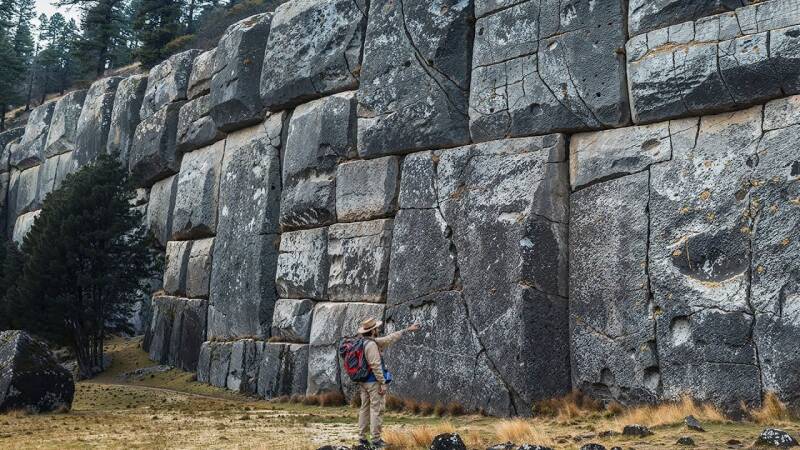
Pictured above: The Sage Wall, discovered in Montana, USA.
Image credit: Freerepublic.com

Pictured above: Stonework attributed to the Incas, Central America.
Image credit: Galactic Connection via Pinterest
The civilizations responsible for these marvels of construction have all vanished without a trace in spite of their obvious advancements in design and engineering, accomplishing feats that cannot be duplicated even with modern methods. None of them have any connection with any thread of known history. Why? How? What disconnect from history could all of these civilizations have in common?
These facts strongly suggest to me that all of these civilizations, including those who built the pyramids, were lost in the Noahic flood. That is the flood of the Noah's ark story. This, if it is true, means, among other things, that the pyramids of Egypt are far older than academia would have us believe. It is this writer's belief that the technology to build such marvels is something taken from us by God in the flood because it is something that He does not want humanity to have any longer. It is a pretty safe bet, in this writer's opinion, that having the means to do these things was something that caused excessive pride among humanity and drove mankind away from God.
When considered objectively, we really don't know what the world was like or what civilization looked like before the Noahic flood. We don't even know for sure how the continents aligned or what the landmasses looked like back then compared to modern maps. It was possibly very different than what academia would have us believe.
I can't prove any of this, but I don't have to. I don't consider these to be important questions, but I do enjoy applying critical thinking to such challenging and interesting mysteries. The opinion of this writer is that we will never understand how and why these structures were built, or by whom. Part of the reason for this is the apparent need by academia to force the solutions to fit within the parameters of our very finite understanding of the world around us, when in fact the truth of it is probably beyond anything we can currently imagine.
And that is quite likely how God wants it to be, and for the good of humanity.
"Act as if what you do makes a difference. It does."
William James
Create Your Own Website With Webador